What Is Semantic SEO? A Plain-English Guide for UK Businesses
If you’ve been doing SEO for a while and suddenly noticed your rankings dropping — even though you’re still using the “right” keywords — you’re not alone.
The problem isn’t your keywords. The problem is that Google has moved on.
Google no longer just reads the words on your page. It tries to understand what your page actually means, what topic it covers, and whether it genuinely helps the person searching.
That shift has a name: Semantic SEO.
In this guide, I’ll explain exactly what semantic SEO is, why it matters for UK businesses in 2026, and how it’s different from the old way of doing things — in plain English, without unnecessary jargon.
Quick summary: Semantic SEO means creating content around topics and meaning rather than just keywords. It helps Google truly understand what your website is about, which leads to better rankings across many searches — not just one keyword at a time.
The Old Way: Why Keyword-Only SEO No Longer Works

To understand semantic SEO, you first need to understand what SEO looked like before it.
In the early days of Google — think 2005 to 2012 — the game was simple. Find a keyword. Use it as many times as possible on your page. Get backlinks. Rank.
If someone searched “cheap car insurance UK”, Google would scan through millions of pages and show the ones that contained those exact words the most. It wasn’t sophisticated. It was basically a counting exercise.
This led to a style of writing that was unnatural and often unreadable:
“Welcome to our cheap car insurance UK page. We offer the best cheap car insurance UK deals for UK drivers. Get your cheap car insurance UK quote today.”
It worked. For a while.
But it created a terrible experience for users — and Google knew it. So they started making their algorithm smarter.
The turning point came in 2013, with the Hummingbird update. For the first time, Google shifted from matching words to understanding meaning. Instead of asking “does this page contain the keyword?”, Google started asking “does this page actually answer what the user is looking for?”
That was the beginning of semantic search — and the end of keyword stuffing as a reliable strategy.
What Is Semantic SEO? (The Clear Definition)
Semantic SEO is the practice of creating content around topics, context, and user intent — rather than isolated keywords — so that search engines understand not just what your page says, but what it actually means.
Let’s break that down:
- Topics over keywords: Instead of targeting one keyword per page, you cover a topic in depth — answering all the questions a reader might have about it.
- Context and entities: You use related terms, concepts, and recognisable names (called “entities”) that help Google understand the full picture of what you’re talking about.
- User intent: You write content that matches what the user is actually trying to achieve, not just what words they typed.
Here’s a simple comparison:
| Old Keyword SEO | Semantic SEO | |
|---|---|---|
| Focus | A single keyword phrase | A topic with many related questions |
| Strategy | Use the keyword as often as possible | Cover the topic fully and naturally |
| Content style | Repetitive, often unnatural | Helpful, conversational, comprehensive |
| Result | Ranks for one keyword (maybe) | Ranks for dozens of related searches |
| Longevity | Fragile — one algorithm update can kill it | Durable — built on genuine topical authority |
How Does Google Understand Meaning?

This is where it gets interesting. How does a search engine actually understand the meaning behind content?
Two technologies make this possible: Natural Language Processing (NLP) and Entities.
Natural Language Processing (NLP)
Natural Language Processing is the technology that allows Google to read your content the way a human does — understanding grammar, relationships between words, and the overall meaning of a sentence.
Before NLP, Google read content like a robot scanning for specific strings of text. After NLP, Google reads it more like a person — understanding that “I need a solicitor in Manchester” and “find me a lawyer near Manchester” are asking for exactly the same thing.
In 2019, Google rolled out BERT (Bidirectional Encoder Representations from Transformers) — a major NLP advancement that dramatically improved Google’s ability to understand the context of an entire search query, not just individual words.
The practical result: Google now understands nuance, synonyms, and the relationship between words in a way it never could before.
Entities and the Knowledge Graph
An entity is any specific person, place, thing, or concept that Google has identified and catalogued in its Knowledge Graph — a massive database of real-world information.
For example:
- London is an entity (Google knows it’s the capital of England, its population, its landmarks, and thousands of related facts)
- HMRC is an entity (Google knows it’s the UK tax authority, related to self-assessment, corporation tax, VAT, and so on)
- Jaguar Land Rover is an entity (Google knows it’s a UK car manufacturer, based in Coventry, related to electric vehicles, the automotive industry, etc.)
When your content uses recognised entities and discusses how they relate to each other, Google builds a much richer understanding of what your page is about — far beyond what any single keyword could communicate.
This is why an article about “UK corporation tax” that naturally mentions HMRC, Companies House, financial year, and self-assessment will rank far better than one that just repeats the phrase “corporation tax UK” over and over.
Semantic SEO vs Traditional SEO — What’s the Real Difference?
People often ask: “Do I have to choose between semantic SEO and traditional SEO?”
The answer is no. Semantic SEO is not a replacement for keyword research, on-page optimisation, or link building. It’s an upgrade to how you think about all of those things.
Here’s the key difference in practice:
Traditional SEO approach: A hair salon in Leeds wants to rank. They create one page targeting “hair salon Leeds”. They stuff that phrase into the title, meta description, headers, and body copy. They wait.
Semantic SEO approach: The same salon creates a cluster of content. Their main page covers the topic of “hair salons in Leeds” comprehensively — mentioning different hair treatments, styles, what to expect on a first visit, pricing expectations, the neighbourhoods they serve. They create supporting articles about “balayage Leeds”, “best hair treatments for damaged hair”, and “how to choose a hairdresser”. All these pages link to each other.
Result: Google understands that this website has genuine authority on the topic of hair salons in Leeds — and ranks it for dozens of searches, not just one.
The traditional approach might get you one ranking. The semantic approach builds an asset that keeps ranking for years.
Why Semantic SEO Matters for UK Businesses in 2026
Semantic SEO has been growing in importance for years, but in 2026, it has become non-negotiable for UK businesses. Here’s why:
1. Google’s AI Overviews are now everywhere. Google now generates AI-powered summaries at the top of search results for many queries. These summaries pull from content that Google trusts as genuinely authoritative and comprehensive. If your content is thin or keyword-stuffed, it won’t get cited. Semantically rich content does.
2. The UK search market is competitive. Whether you’re in Manchester, Birmingham, or a smaller UK town, you’re competing with businesses that have been investing in their websites for years. Topical authority — built through semantic SEO — is one of the clearest ways to differentiate your site without having an enormous budget.
3. People search in natural language. With voice search on mobile and smart speakers, UK users are increasingly searching in full sentences: “What’s the best mortgage deal for first-time buyers in the UK right now?” Semantic SEO is built for exactly this kind of query — keyword stuffing is not.
4. Google’s quality guidelines reward depth. Google’s E-E-A-T framework (Experience, Expertise, Authoritativeness, Trustworthiness) rewards content that demonstrates real knowledge. A comprehensive, well-structured article on a topic demonstrates expertise far better than a thin, keyword-loaded page.
5. It compounds over time. Every piece of content you add to a topic cluster strengthens the authority of every other piece. It’s a compounding asset. Traditional keyword SEO doesn’t give you that — each page stands alone.
The 5 Core Elements of a Semantic SEO Strategy

Now that you understand what semantic SEO is, here’s what it looks like in practice. A proper semantic SEO strategy has five key elements:
1. Topic Clusters and Pillar Pages
The backbone of semantic SEO is organising your content into topic clusters.
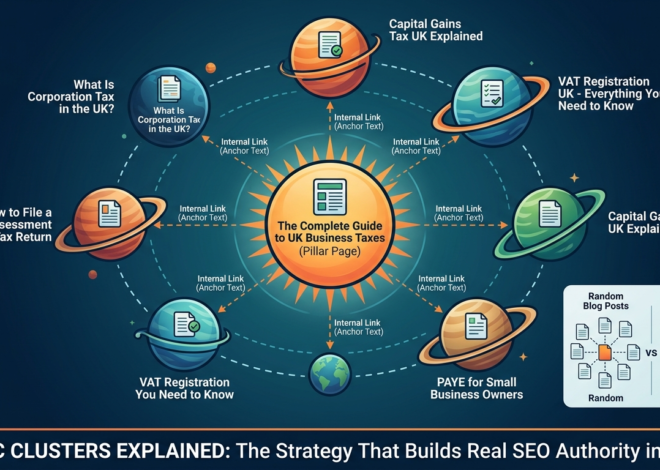
A topic cluster works like this: you have one main “pillar page” that covers a broad topic comprehensively. Then you have multiple “cluster articles” that each dive deep into a specific subtopic — and all of them link back to the pillar page.
For example, if you run a UK accounting firm, your pillar page might cover “UK Business Taxes” in overview. Your cluster articles would each cover one specific tax topic in detail: VAT, corporation tax, self-assessment, Capital Gains Tax, and so on.
This structure tells Google: this website has serious, organised, in-depth knowledge about UK business taxes. That’s topical authority.
2. Entity Optimisation
Entities are the recognisable people, places, organisations, and concepts that Google has catalogued. Mentioning relevant entities naturally throughout your content helps Google understand what world your content belongs to.
If you write about SEO, mentioning Google, Search Console, Core Web Vitals, and John Mueller is natural — and it reinforces your topical relevance. If you’re writing about UK financial advice, mentioning the FCA, ISAs, and HMRC does the same job.
You don’t need to force this. Just write naturally about your topic, and the relevant entities will appear organically.
3. Semantic (LSI) Keywords
LSI (Latent Semantic Indexing) keywords are related words and phrases that naturally surround your main topic.
If your main topic is “semantic SEO”, your LSI keywords would include: search intent, topic clusters, natural language processing, entities, structured data, BERT, topical authority, content clusters, and schema markup.
These terms don’t need to be used a specific number of times. They just need to appear naturally because you’re covering the topic properly. When Google sees them, it confirms that your page is genuinely about the topic — not just optimised to appear relevant.
4. Search Intent Matching
Every search query has an intent behind it. Someone searching “what is semantic SEO” wants to learn. Someone searching “semantic SEO agency UK” wants to hire someone. Someone searching “Semrush vs Ahrefs” wants to compare options before making a decision.
Matching your content’s format and depth to the intent of the search is fundamental to semantic SEO. An informational query needs a thorough, educational article. A transactional query needs a clear, conversion-focused page. Getting this wrong — no matter how good your writing is — will hurt your rankings.
5. Schema Markup and Structured Data
Schema markup is a small piece of code you add to your website that directly tells Google what your content is about — in a language Google understands perfectly.
For a blog article, Article schema tells Google it’s an article, who wrote it, when it was published, and what it’s about. FAQPage schema tells Google which part of your page contains questions and answers, making you eligible for rich results in search.
Schema doesn’t directly boost your rankings, but it helps Google understand your content faster and more accurately — and it can significantly improve how your result looks in search (with star ratings, FAQ dropdowns, and so on), which increases the number of people who click through.
A Real Example — Semantic SEO in Action for a UK Business
Let me make this concrete with an example.
Meet Sarah, who runs an independent financial planning firm in Bristol. She wants to rank on Google for keywords related to financial advice in Bristol.
The old approach: Sarah creates one page called “Financial Adviser Bristol” and sprinkles that phrase throughout the page. She waits for months and barely moves in the rankings because dozens of other Bristol advisers have done the same thing.
The semantic SEO approach: Sarah builds a topic cluster around “financial planning for UK professionals”. Her pillar page gives a comprehensive overview. Her cluster articles each cover one specific area:
- “How to start a pension as a self-employed person in the UK”
- “ISA vs pension — which is better for UK higher-rate taxpayers?”
- “How much do financial advisers charge in the UK?”
- “What to expect at your first financial planning meeting”
- “SIPP explained — a guide for UK business owners”
All these articles link back to her pillar page, and to each other. She mentions entities like the FCA, HMRC, ISA allowances, and the Pension Lifetime Allowance naturally throughout.
Within 4–6 months, Sarah’s website begins ranking for dozens of related searches — not just “financial adviser Bristol”, but all the long-tail queries her future clients are typing into Google at every stage of their decision-making journey.
That’s semantic SEO working as it should.
FAQ — Semantic SEO Questions UK Businesses Ask
Is semantic SEO the same as keyword SEO?
No, but keywords are still part of semantic SEO. The difference is that in semantic SEO, keywords sit within a broader topic and intent framework. You’re not targeting a keyword — you’re covering a topic. Keywords help you understand what your audience is searching for, but they’re the starting point, not the entire strategy.
How long does semantic SEO take to show results?
Realistically, 3 to 6 months for new content on a newer website. If you’re updating existing content that already has some authority, you might see improvements in 4 to 8 weeks. The February 2026 Google core update and ongoing algorithm changes mean rankings can fluctuate in the early weeks — that’s normal. Focus on consistent, quality content creation rather than expecting overnight results.
Do I need technical skills to do semantic SEO?
For most of it, no. Content strategy, topic cluster planning, and search intent research are all non-technical. Schema markup and site architecture benefit from some technical knowledge — but even those can be handled with plugins like Yoast SEO or Rank Math on WordPress without touching code.
Does semantic SEO work for small UK businesses?
Yes — and small UK businesses often benefit more from semantic SEO than large ones. A large brand can rank on domain authority alone. A small business needs to earn its place through genuine topical expertise. Semantic SEO lets you build deep authority in a specific niche without competing on advertising budgets.
Where to Start with Semantic SEO for Your UK Website
If you’ve reached this point and you’re thinking “right, I need to do this” — here are your first three steps:
Step 1: Pick your core topic. What is your website genuinely expert in? That’s your first pillar page topic. Don’t try to cover everything at once. Start with one topic cluster and build it out properly.
Step 2: Map your cluster. Write down every question your target customer might have about that topic. Each question is a potential cluster article. Aim for 6 to 10 cluster articles around each pillar page.
Step 3: Write for the reader, not the algorithm. The most important rule in semantic SEO is also the simplest: create content that genuinely helps the person reading it. Comprehensive, honest, well-structured content is exactly what Google’s algorithm is now designed to reward.